

Over the past decade, Zero Waste to Landfill has become one of the most visible commitments in corporate sustainability reports. It appears in ESG disclosures, investor presentations, and annual reports—often positioned as proof of environmental leadership.
For many organisations, the intent is genuine. Zero waste signals responsibility, efficiency, and alignment with global sustainability goals. It reassures stakeholders that waste is being taken seriously, not ignored.
But once the pledge is made, a tougher question emerges:
How does a large, decentralised organisation actually achieve zero waste—every day, across every site?
Why Zero-Waste Pledges Struggle on the Ground
Most corporations do not fall short because they lack ambition. They struggle because waste systems were never designed for zero waste in the first place.
Common challenges surface quickly:
Waste is outsourced, reducing visibility and control
Organic waste from canteens and cafeterias is mixed and sent to landfills
Recycling rates are estimated, not measured
Audit readiness depends on vendor certificates rather than primary data
Zero waste becomes an annual reporting exercise, not an operational metric
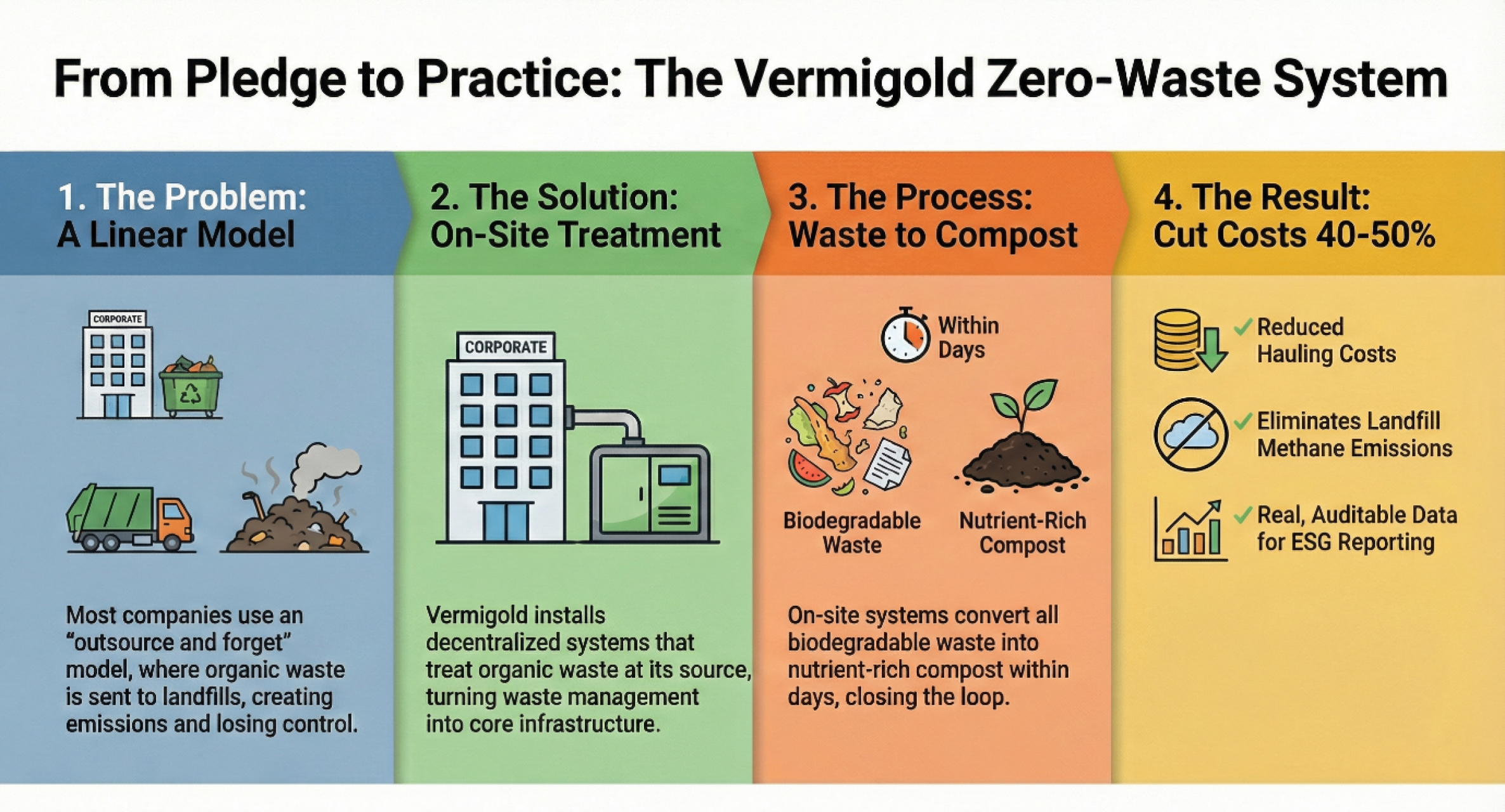
Despite bold commitments, many organisations still operate a linear waste model:
Procure → Consume → Dispose → Outsource → Report
In this model, waste disappears from view—but not from environmental impact. Landfills continue to receive biodegradable waste, emissions persist, and zero waste remains a statement rather than a system.
Turning Zero Waste into an Operating Model
Zero waste becomes achievable when waste management is redesigned as core infrastructure, not an external service.
The most effective transformation begins with organic waste—often 40–60% of total corporate waste by volume, and the largest contributor to landfill emissions.
At Vermigold Ecotech, zero waste is operationalised through decentralised, on-site organic waste management systems that convert biodegradable waste into nutrient-rich compost within days.
What changes when zero waste is built into operations:
Organic waste is treated at source, not transported to landfills
Methane emissions from disposal are avoided entirely
Waste diversion becomes measurable and auditable
Disposal and hauling costs drop significantly
Employees engage because waste is visible and tangible
In practice, a single large facility can divert hundreds of tonnes of organic waste annually, reduce waste-related costs by 40–50%, and generate compost for landscaping or local agriculture—closing the loop within its own ecosystem.
Zero waste stops being a future goal.
It becomes a daily process.
Zero Waste Is Not a Destination—It’s a Discipline
The most important insight for corporate leaders is this:
Zero waste is not achieved by declarations.
It is achieved by design.
When waste systems are decentralised, measured, and integrated into everyday operations, zero waste shifts from aspiration to reality. ESG disclosures become easier because data already exists. Audits become smoother because processes are consistent. Compliance becomes proactive rather than reactive.
Organisations that succeed at zero waste do not treat it as a sustainability project. They treat it as an operating discipline—just like quality, safety, or compliance.
In a world of rising ESG scrutiny and regulatory oversight, that discipline is what separates genuine leadership from symbolic commitments.
Zero waste to landfill is achievable.
But only when it moves off the page - and onto the factory floor.
Ready to Move from Pledge to Practice?
♻️ Design zero-waste systems that scale across sites
📊 Strengthen ESG and audit readiness with real data
🌱 Eliminate landfill dependency at source
👉 Speak with the Vermigold team to build a zero-waste roadmap for your organisation.