

In most organisations, waste management appears in budgets as a necessary expense—a line item tied to hauling, tipping fees, compliance, and vendor contracts. It is rarely discussed in terms of value creation or cost optimisation.
At the same time, businesses are under pressure to reduce operating costs, improve ESG performance, and demonstrate efficiency across every function. Finance leaders scrutinise energy, procurement, and logistics—but waste often escapes the same level of analysis.
This is a missed opportunity.
Because when waste is examined closely, it becomes clear that inefficient waste systems quietly drain capital every day.
The Hidden Costs of “Business-as-Usual” Waste Management
Traditional waste management models rely heavily on outsourcing and landfills. While this may appear simple, it carries several hidden and compounding costs:
Rising hauling and landfill tipping fees
Fuel and logistics costs tied to daily waste transport
Penalties and compliance risks from poor segregation
Loss of recoverable materials, especially organic waste
Dependence on vendors with limited transparency or data
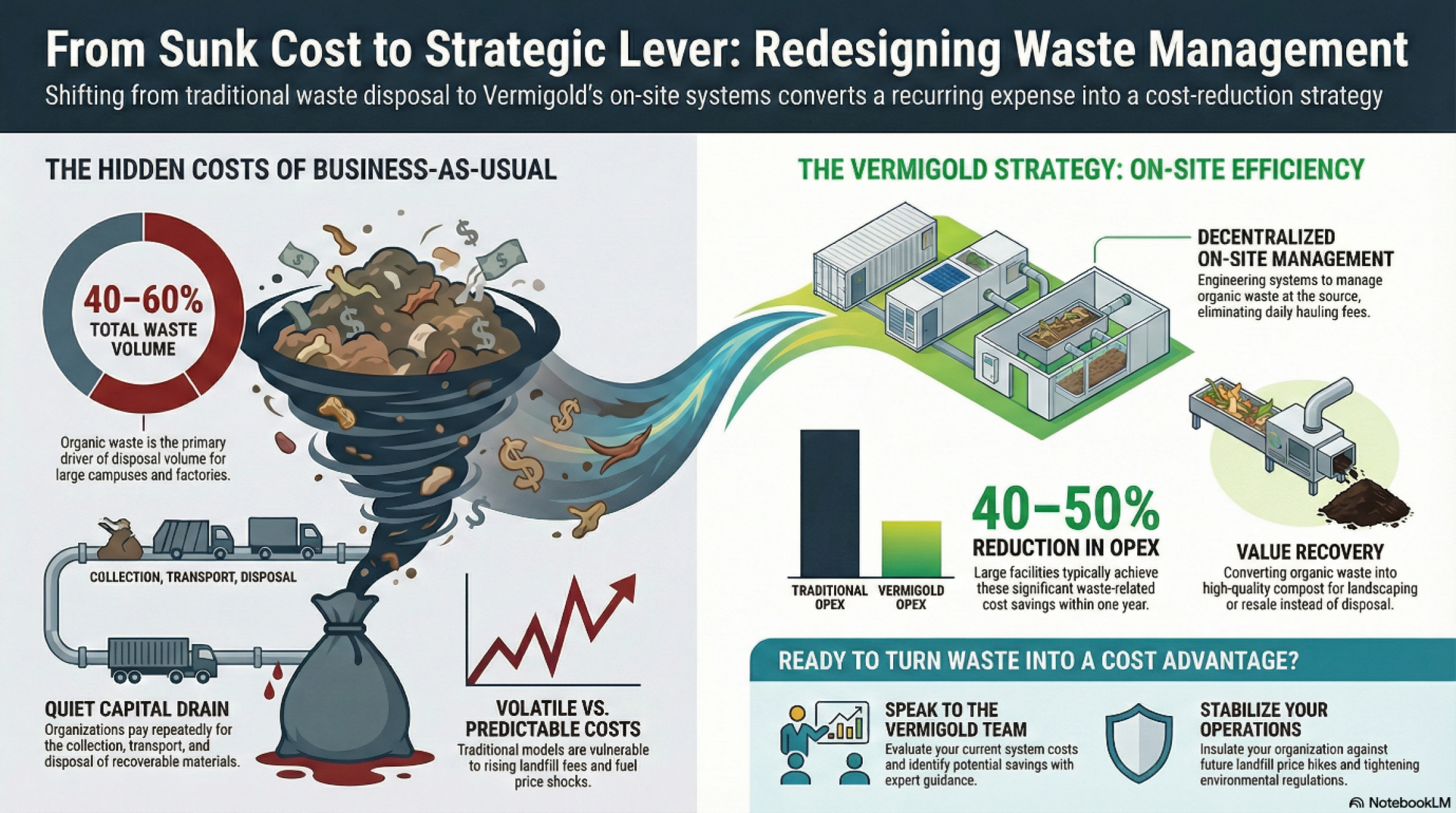
For large campuses, factories, and institutions, organic waste alone can account for 40–60% of total waste volume. When this stream is landfilled, organisations pay repeatedly—for collection, transport, disposal, and environmental impact.
The irony is striking:
companies spend money to throw away material that still has economic value.
As sustainability goals grow, many organisations attempt to offset these costs with credits or certifications—adding yet another expense without addressing the root inefficiency.
Redesigning Waste as an Operating Cost Lever
Waste stops being an expense when it is designed into operations, not exported out of them.
The turning point comes when organisations treat waste management as a cost-reduction and efficiency strategy, particularly for organic waste.
At Vermigold Ecotech, waste systems are engineered to reduce recurring costs while delivering environmental outcomes.
By implementing decentralised, on-site organic waste management systems, organisations can:
Eliminate or sharply reduce daily hauling and tipping fees
Cut fuel and logistics costs linked to waste transport
Reduce compliance and penalty risk through better segregation
Convert organic waste into compost for landscaping or resale
Generate measurable data for ESG and audit reporting
In practice, many large facilities see 40–50% reduction in waste-related operating costs within the first year. What was once a recurring expense becomes a controllable variable.
Even more importantly, costs stabilise. As landfill fees rise and regulations tighten, organisations with on-site systems insulate themselves from future price shocks.
Waste management shifts from a volatile expense to predictable infrastructure.
The Most Efficient Companies Waste the Least
Cost leadership has always been about eliminating inefficiency. Waste—by definition—is inefficiency.
When organisations redesign waste systems to retain control, recover value, and reduce dependence on landfills, the financial logic becomes undeniable. Sustainability initiatives stop competing with cost objectives. They reinforce them.
The most mature organisations no longer ask, “What does waste management cost us?”
They ask, “What does poor waste management cost us?”
Because once waste is measured, managed, and monetised correctly, it becomes clear that the real expense is continuing with systems that were never designed for efficiency.
Waste management is not a sunk cost.
It is an operational lever.
And organisations that recognise this early don’t just become more sustainable—they become more resilient, more efficient, and more competitive.
Ready to Turn Waste into a Cost Advantage?
📉 Reduce recurring waste disposal and logistics costs
📊 Stabilise operations against rising landfill fees
♻️ Convert organic waste into a usable resource
👉 Speak with the Vermigold team to evaluate how much your current waste system is really costing you—and how much you can save.