

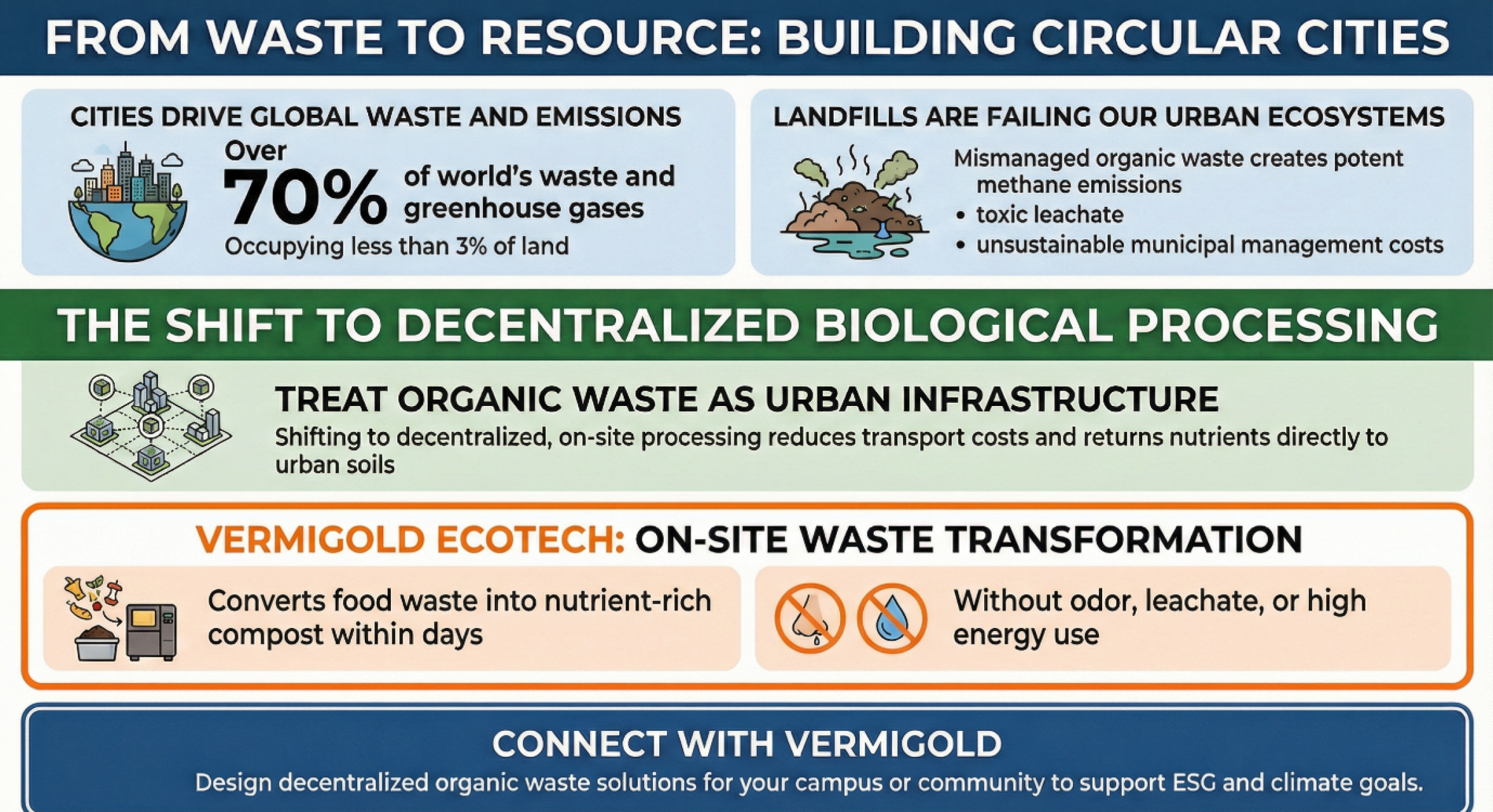
Cities occupy less than 3% of the Earth’s land area—but they generate over 70% of global waste and emissions. As urban populations expand, cities are under unprecedented pressure to manage waste, reduce emissions, and maintain public health, all while operating within limited land and infrastructure.
In this complex equation, organic waste plays a central but often overlooked role.
Food scraps, vegetable waste, garden trimmings, and biodegradable materials form the single largest component of municipal solid waste in Indian cities. How cities manage this stream determines not only landfill pressure, but air quality, climate impact, and the long-term sustainability of urban ecosystems.
When Organic Waste Undermines Urban Sustainability
Organic waste is not inherently problematic. The crisis begins when it is mismanaged.
In most cities, organic waste is mixed with other waste streams and transported to landfills. There, it decomposes anaerobically, releasing methane—a greenhouse gas significantly more potent than carbon dioxide. Leachate contaminates soil and groundwater. Transporting waste across long distances adds further emissions and costs.
The consequences are visible:
Overburdened landfills nearing capacity
Rising municipal waste management costs
Increased methane emissions contributing to climate change
Public health risks from odour, pests, and water contamination
Loss of valuable nutrients that could restore urban soils
Ironically, cities spend heavily to remove organic waste, and then spend again importing fertilisers and soil conditioners—while dumping nutrients daily.
This linear system works against the very idea of sustainable cities.
Organic Waste as Urban Infrastructure, Not Garbage
Sustainable cities emerge when organic waste is treated as urban infrastructure, not refuse.
The solution lies in decentralised, biological processing—handling organic waste close to where it is generated, and returning it safely to natural cycles.
When cities adopt decentralised composting and on-site organic waste management:
Organic waste is diverted before reaching landfills
Methane emissions are avoided at source
Waste transport and municipal load are reduced
Compost is generated for parks, gardens, and urban green spaces
Nutrients remain within the city’s ecological loop
At Vermigold Ecotech, this approach is implemented through decentralised organic waste management systems that convert food and biodegradable waste into nutrient-rich compost within days—without odour, leachate, or heavy energy use.
Housing societies, campuses, markets, and institutions become nodes of regeneration, reducing pressure on centralised landfills while contributing to greener neighbourhoods.
In effect, organic waste becomes a connector—linking waste management, climate action, public health, and urban resilience.
Sustainable Cities Are Built on Biological Cycles
The future of sustainable cities will not be defined only by smart grids, electric transport, or digital infrastructure. It will also depend on how cities manage their most basic biological flows.
Organic waste represents a powerful opportunity:
To reduce emissions quickly
To restore urban soils and green spaces
To lower municipal waste costs
To build circular, resilient neighbourhoods
Cities that succeed will be those that close the organic loop—treating waste as a resource, processing it locally, and reintegrating it into the urban ecosystem.
Sustainability in cities is not just about technology.
It is about respecting natural cycles—especially within dense, human-made environments.
When organic waste is managed well, cities become cleaner, healthier, and more resilient.
When it is ignored, sustainability goals remain out of reach.
The choice, increasingly, is an urban one.
Ready to Build Organic-Waste–Smart Cities?
🏙 Reduce landfill pressure and methane emissions
🌱 Turn city waste into soil and green infrastructure
📊 Support policy, ESG, and climate goals at the urban level
👉 Speak with the Vermigold team to design decentralised organic waste solutions for cities, campuses, and communities.