

The Search for Waste Solutions That Actually Work
As cities expand and businesses scale, organic waste has emerged as one of the most persistent sustainability challenges. Food waste, garden waste, and biodegradable materials form the largest share of municipal and institutional waste—yet they are often managed using systems designed for disposal, not recovery.
Landfilling organic waste leads to methane emissions, rising costs, and lost nutrients. Incineration destroys biological value entirely. Against this backdrop, organisations are increasingly asking a practical question:
Can organic waste be processed efficiently, safely, and continuously—without environmental trade-offs?
The answer lies not in complex chemistry, but in biology.
Why Conventional Waste Processing Falls Short
Most conventional waste systems struggle with organic waste for three fundamental reasons:
Anaerobic breakdown produces foul odour and methane
Batch-based composting is slow, space-intensive, and labour-heavy
Poor control of biological conditions leads to inconsistent output
These limitations make many systems unsuitable for corporate campuses, housing societies, factories, and institutions—where waste is generated daily and hygiene, predictability, and compliance matter.
What is needed is not brute-force processing, but a system that works with natural decomposition processes, not against them.
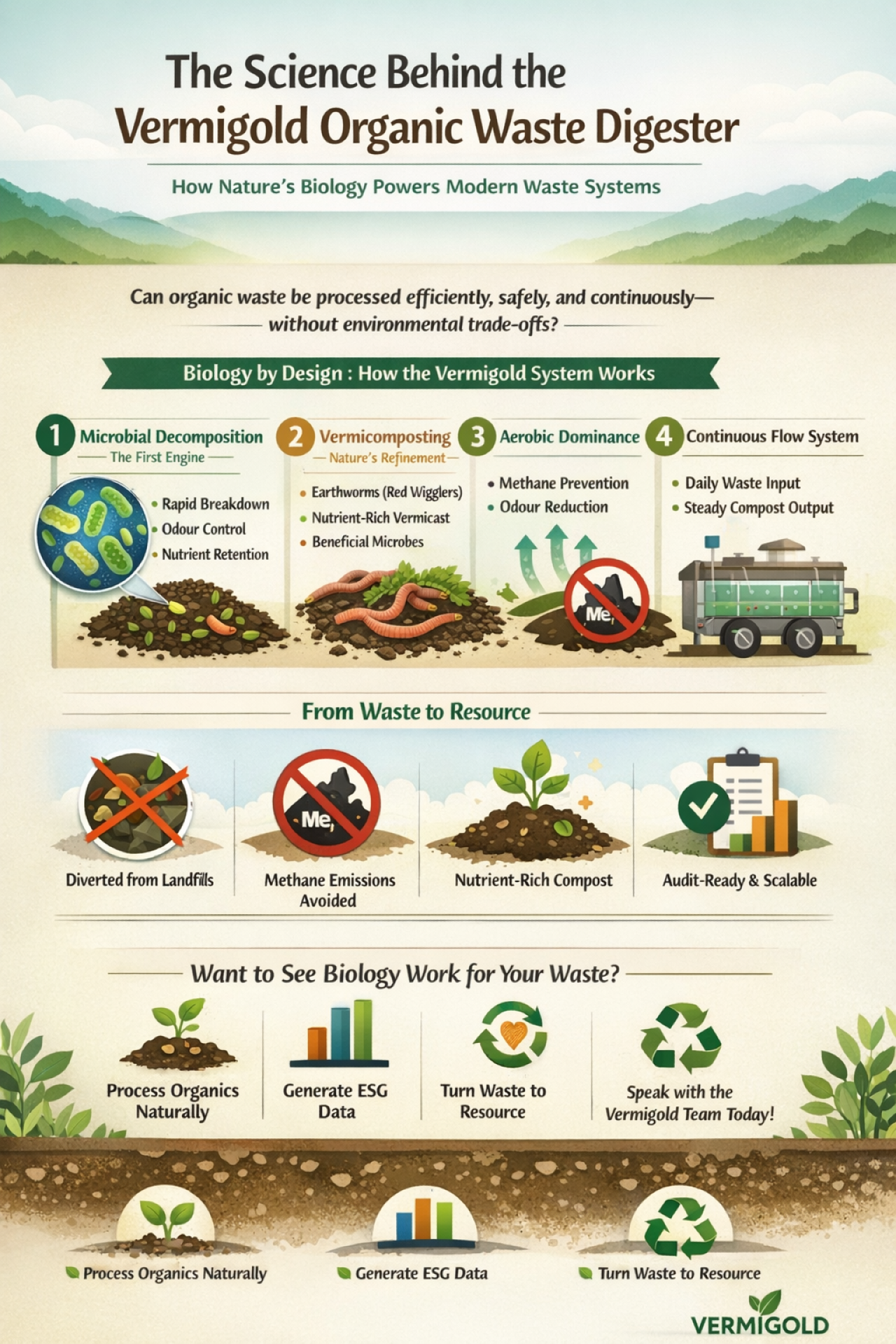
Biology by Design — How the Vermigold System Works
At Vermigold Ecotech, the Organic Waste Digester is engineered around a simple but powerful principle:
Nature already knows how to break down organic matter efficiently—if the conditions are right.
The Vermigold system combines vermicomposting, microbial digestion, and controlled aeration into a continuous-flow, in-vessel design.
1. Microbial Decomposition (The First Engine)
Specially selected aerobic microbes initiate rapid breakdown of organic waste in an oxygen-rich environment. This ensures:
Faster volume reduction
Suppression of odour-causing anaerobic bacteria
High nutrient retention in the final output
2. Vermicomposting (Nature’s Refinement Process)
Earthworms—primarily Eisenia fetida (red wigglers)—form the biological core of the system. As waste passes through their digestive systems:
Complex organic matter is converted into stable, nutrient-rich vermicast
Beneficial microbes are introduced naturally
Soil-friendly compounds are enhanced
Earthworms don’t just consume waste—they upgrade it.
3. Aerobic Dominance
While the overall system is aerobic (preventing methane formation), the digester design allows controlled micro-environments that:
Aid breakdown of complex organic molecules
Further reduce odour
Improve compost maturity
This balance ensures efficiency without environmental harm.
4. Continuous Flow Engineering
Unlike batch composting, the Vermigold system operates continuously:
Organic waste can be added daily
Compost is generated steadily
No downtime, turning, or curing piles required
This makes the system ideal for real-world, daily waste generation.
5. Controlled Biological Conditions
Moisture, aeration, temperature, and material flow are optimised by design—ensuring:
Stable worm populations
Consistent output quality
Minimal operator intervention
The result is a system where biology performs reliably at scale.
Closure: When Science Turns Waste into Infrastructure
The Vermigold Organic Waste Digester is not a mechanical shortcut—it is a biological system, scientifically engineered for reliability.
By leveraging:
Aerobic microbial action
Vermicomposting biology
Continuous-flow engineering
the system converts up to 90% of organic waste into usable compost, aligned with environmental regulations and sustainability goals.
What this means in practice:
Organic waste is diverted from landfills
Methane emissions are avoided at source
Compost improves soil health without chemical fertilisers
Waste systems become predictable, auditable, and scalable
This is not just waste management.
It is biological infrastructure—quietly operating every day.
As sustainability expectations rise, systems that mimic and respect natural processes will outperform those that try to overpower them.
The science is simple.
The design is intentional.
And the impact is measurable.
Want to See Biology Work for Your Waste?
🌱 Process organic waste naturally—without odour or landfill dependence
📊 Generate ESG- and audit-ready waste diversion data
♻️ Turn daily waste into a regenerative resource
👉 Speak with the Vermigold team to understand how biological waste systems can work at your scale.