

Across India, waste management has moved from the periphery of operations to the centre of sustainability conversations. Rapid urbanisation, rising consumption, tighter regulations, and growing ESG scrutiny have forced organisations to confront a simple reality:
How waste is managed now directly reflects how responsibly an organisation operates.
Yet for most businesses, campuses, and institutions, waste management still functions as a logistical afterthought—outsourced, opaque, and disconnected from broader sustainability goals. Organic waste, which forms the largest share of total waste, is often transported to landfills, generating emissions, costs, and regulatory risk.
This gap between sustainability intent and operational reality is where meaningful solutions are needed.
When Conventional Waste Systems Stop Working
Consider the typical waste management model:
Waste is collected, mixed, and transported off-site
Landfills or distant processing facilities absorb the burden
Organisations lose visibility, control, and accountability
Costs rise steadily due to hauling, tipping, and compliance
Sustainability reporting relies on estimates rather than data
For organic waste in particular, this model is deeply inefficient. Landfilled food and biodegradable waste decompose anaerobically, producing methane—a greenhouse gas far more potent than CO₂. What could have been a resource becomes an environmental liability.
As regulations tighten and ESG expectations rise, this approach is increasingly unsustainable—operationally, financially, and reputationally.
Vermigold’s Systems-Led Approach to Sustainable Waste Management
The shift begins when waste is treated not as something to be removed, but as something to be managed at source and reintegrated into natural cycles.
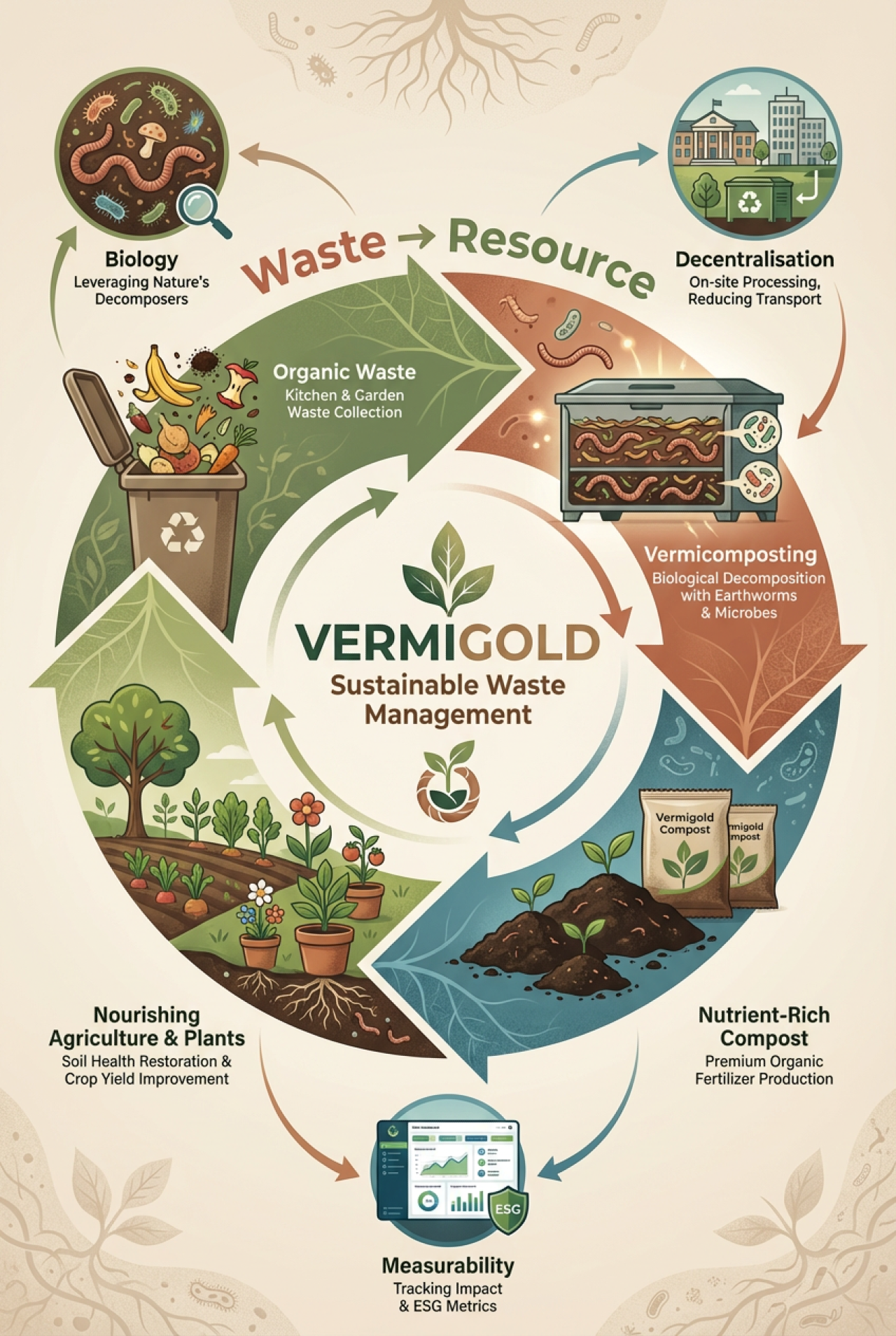
At Vermigold Ecotech, sustainable waste management is built on three core principles: biology, decentralisation, and measurability.
1. Biology That Works With Nature
Vermigold’s systems leverage natural biological processes—vermicomposting and aerobic microbial digestion—to break down organic waste efficiently. Instead of burning, burying, or exporting waste, the system allows nature to do what it does best: convert organic matter into nutrient-rich compost.
This avoids methane formation, eliminates odour, and preserves soil value.
2. Decentralisation at the Point of Generation
Rather than relying on centralised landfills or distant processing plants, Vermigold systems operate on-site—in campuses, institutions, housing societies, markets, and public spaces.
This decentralised approach:
Eliminates transport-related emissions and costs
Improves hygiene and operational control
Reduces dependence on municipal infrastructure
Makes waste management visible and accountable
3. Measurable Outcomes, Not Assumptions
Sustainability today is judged by data.
Vermigold systems generate clear, auditable metrics—waste processed, landfill diversion achieved, compost produced—enabling organisations to support ESG disclosures, compliance requirements, and impact reporting with confidence.
Waste management shifts from narrative to evidence.
From Waste Handling to Value Creation
Vermigold’s value proposition is not limited to waste disposal. It lies in redefining the role of waste in modern systems.
When organic waste is processed at source:
Environmental impact is reduced immediately
Operating costs stabilise and often decline
Compliance becomes proactive rather than reactive
Compost supports landscaping, agriculture, and green spaces
Sustainability becomes embedded into daily operations
This is not a temporary fix or a symbolic initiative. It is infrastructure—quietly operating every day, delivering environmental, economic, and governance value over time.
In a future where sustainability expectations will only intensify, organisations need systems that are resilient, transparent, and grounded in science.
That is what Vermigold unlocks.
Not just better waste management—but a smarter, more sustainable way to close the loop.
Ready to Unlock Sustainable Waste Management?
♻️ Manage organic waste at source—without odour or landfill reliance
📊 Strengthen ESG and compliance with real data
🌱 Turn waste into a regenerative resource
👉 Connect with the Vermigold team to explore how decentralised, biology-led waste systems can work for your organisation.