

Waste management is no longer a background municipal service—it is fast becoming a defining challenge of our time. Rapid urbanisation, changing consumption patterns, and growing environmental awareness have forced cities, businesses, and institutions to confront an uncomfortable reality:
the way we manage organic waste today will shape the environmental outcomes of tomorrow.
Across households, commercial kitchens, campuses, and industries, organic waste makes up the largest portion of what we throw away. Traditionally, this waste has been treated as something to be removed and forgotten. But as sustainability priorities sharpen, that mindset is beginning to shift.
Waste is no longer just a burden.
It is a system waiting to be redesigned.
Why Traditional Waste Disposal Is No Longer Viable
The scale of the organic waste problem is immense. Millions of tonnes of food scraps and biodegradable materials are generated every year, and much of it still ends up in landfills or incinerators.
This approach comes at a high cost:
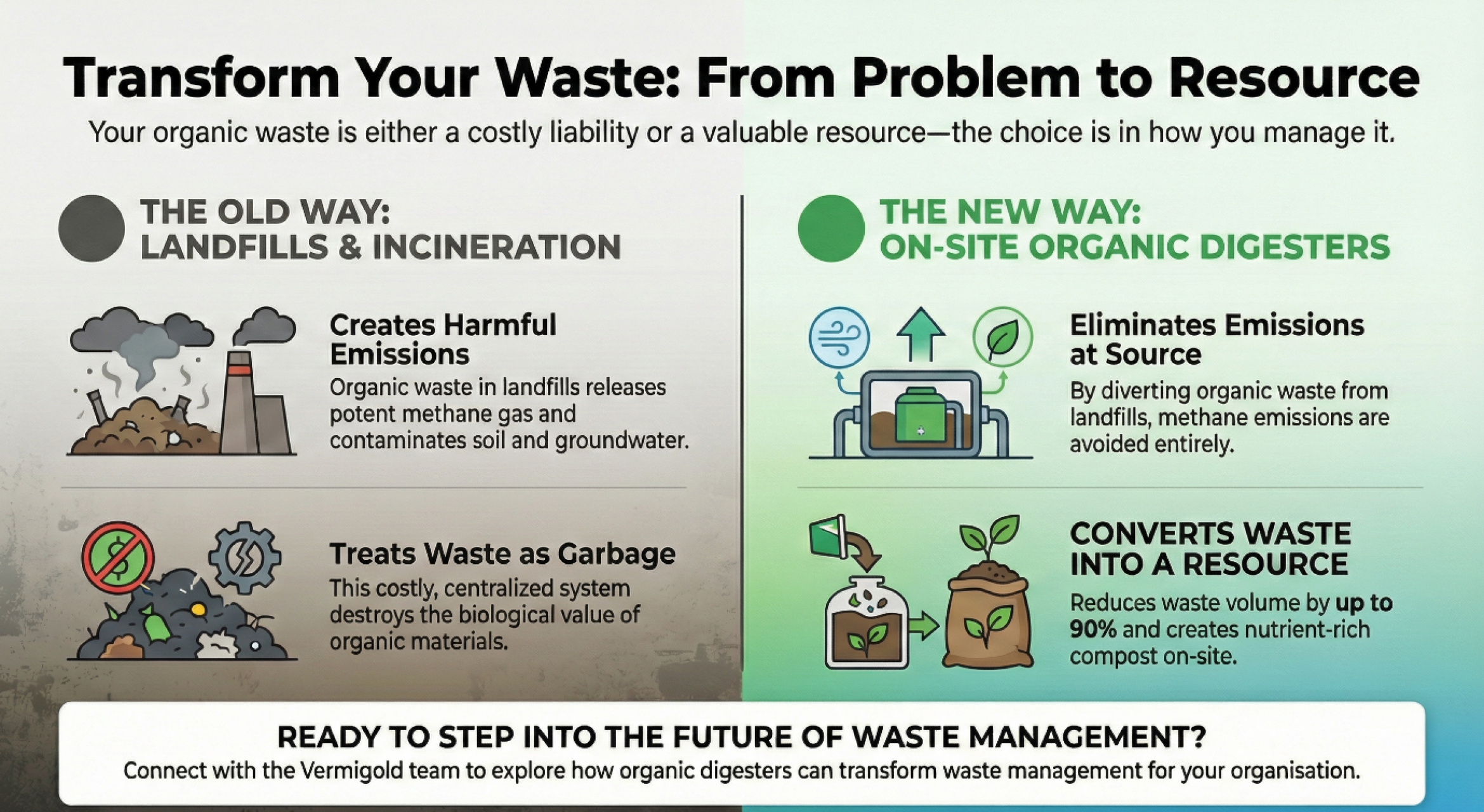
Organic waste in landfills decomposes anaerobically, releasing methane—a greenhouse gas far more potent than CO₂
Landfills contaminate soil and groundwater through leachate
Incineration destroys biological value while generating emissions
Centralised disposal systems are expensive, opaque, and increasingly unsustainable
Despite decades of effort, conventional waste management methods struggle to keep pace with rising volumes and environmental expectations. The result is a system that manages waste after it becomes a problem, rather than preventing the problem at source.
The question facing the sector is clear:
How can organic waste be processed efficiently, cleanly, and continuously—without shifting the burden elsewhere?
Organic Digesters Redefine How Waste Is Treated
The breakthrough comes from working with biology instead of fighting it.
Organic digesters use controlled biological processes—such as aerobic microbial digestion and vermicomposting—to accelerate the natural breakdown of organic waste. Unlike traditional composting, these systems operate in enclosed, managed environments, allowing waste to be processed faster, with minimal odour and space requirements.
At Vermigold Ecotech, organic digesters are engineered to function as on-site, continuous systems, capable of handling daily waste generation in real-world settings.
What changes when organic digesters are introduced:
Organic waste is diverted from landfills at source
Waste volume is reduced by up to 90% through biological breakdown
Methane emissions from landfill disposal are avoided entirely
Nutrient-rich compost is produced as a usable end product
Waste management becomes predictable, hygienic, and measurable
Instead of treating waste as garbage, digesters transform it into a resource—supporting soil health, landscaping needs, and circular economy goals.
For organisations, this means lower disposal costs, reduced environmental risk, and stronger sustainability outcomes without relying on distant infrastructure.
A Future Where Waste Becomes Part of the Solution
The future of waste management will not be defined by larger landfills or faster disposal. It will be shaped by systems that prevent waste from becoming a problem in the first place.
Organic digesters represent this shift. They decentralise waste processing, reduce emissions at source, and return biological material to productive use. As technology improves and adoption increases, these systems are becoming more efficient, scalable, and accessible across sectors.
Governments, institutions, and businesses are beginning to recognise that sustainable waste management is not just about compliance—it is about resilience.
In a future driven by circular economy principles, waste will no longer mark the end of a product’s life.
It will signal the start of something new.
Organic digesters are not just changing how we manage waste.
They are redefining what waste means.
Ready to Step Into the Future of Waste Management?
♻️ Reduce landfill dependence and emissions at source
🌱 Convert organic waste into valuable compost
📊 Build sustainable, data-driven waste systems
👉 Connect with the Vermigold team to explore how organic digesters can transform waste management for your organisation.