

Modern campuses—whether IT parks, manufacturing plants, universities, or institutional facilities—no longer function as simple workplaces. They operate like micro-cities.
Thousands of people.
Daily food services and canteens.
Landscaped green areas.
Continuous material and waste flows.
As ESG expectations rise, these campuses have become highly visible symbols of a company’s sustainability commitment. Stakeholders increasingly look beyond policies and ask a practical question:
How sustainably does this campus actually operate—day to day?
Waste management, especially organic waste, sits at the centre of that answer.
Why Campus Waste Systems Break Down
Despite sustainability goals, many large campuses struggle with waste for structural reasons.
Common issues include:
Centralised waste collection that hides inefficiencies
Organic waste from canteens mixed and sent to landfills
Odour, hygiene, and space constraints discouraging on-site solutions
Outsourced waste handling with limited traceability
Sustainability teams dependent on estimates for reporting
The result is a familiar pattern:
waste leaves the campus quickly—but accountability leaves with it.
For IT parks, factories, and institutions aiming for green certifications, ESG compliance, or zero-waste goals, this creates a gap between what is promised and what is operationally possible.
Designing Waste Infrastructure for Campus Reality
Sustainable campuses require waste systems designed for scale, density, and daily use—not afterthoughts bolted on for compliance.
The turning point comes when waste is treated as infrastructure, not logistics.
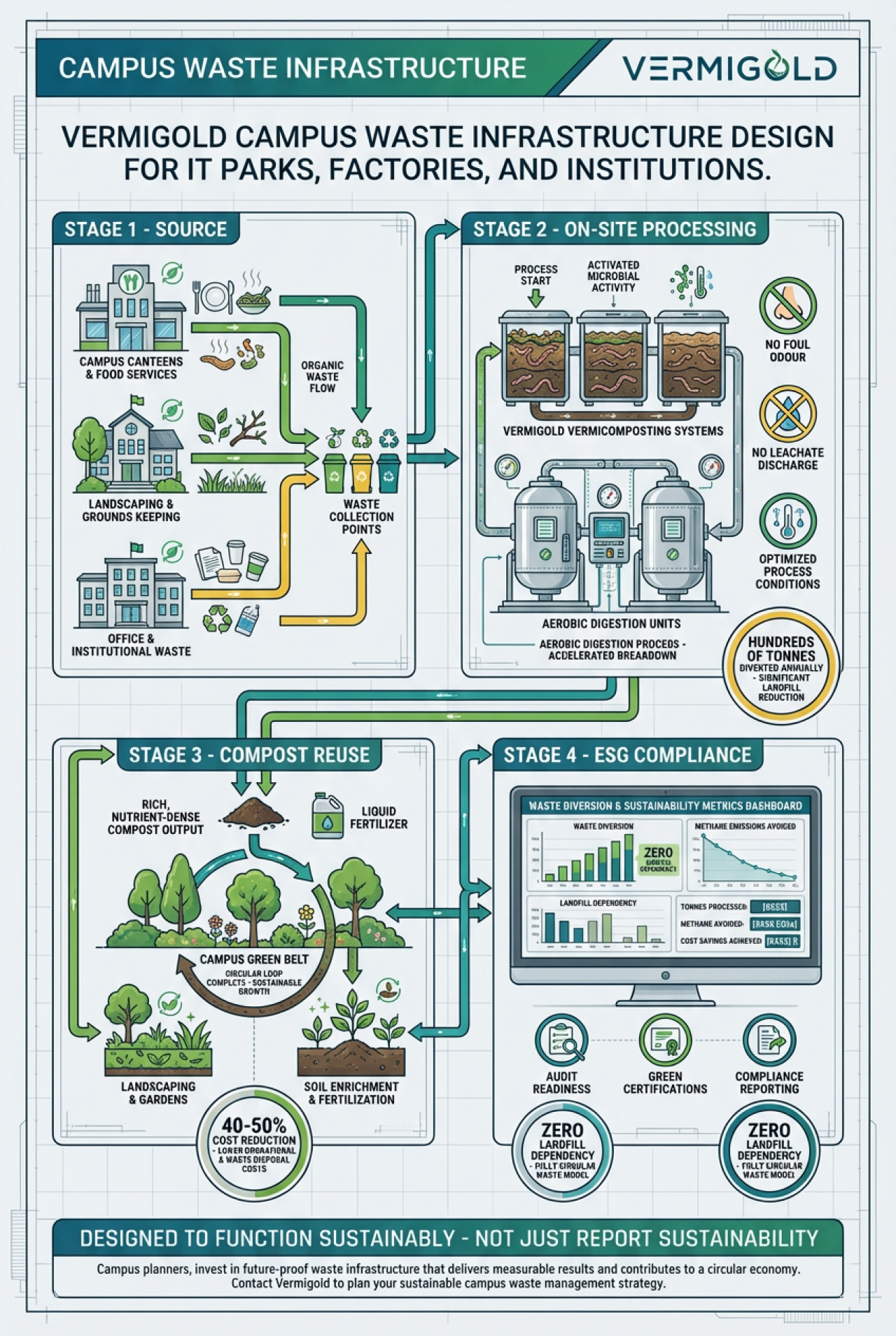
At Vermigold Ecotech, campus waste management is approached through decentralised, on-site organic waste systems that align with how campuses actually function.
What changes when waste is processed on-site:
Organic waste from canteens is treated at source
No dependence on daily hauling or landfill disposal
Systems operate without foul odour or leachate—critical for campuses
Compost is reused within the campus for landscaping and green belts
Waste diversion data is captured for ESG, audits, and certifications
For a large IT park or factory campus, this can mean diverting hundreds of tonnes of organic waste annually, reducing disposal costs by up to 40–50%, and significantly lowering methane-linked emissions.
More importantly, waste becomes visible and educational—encouraging employee and student participation in sustainability.
Sustainable Campuses Are Built, Not Claimed
The most successful sustainable campuses share one trait:
they are designed to function sustainably—not just report sustainability.
When waste infrastructure is decentralised, measurable, and integrated into campus operations, sustainability becomes part of everyday behaviour. Green certifications become easier to achieve. ESG reporting becomes defensible. Compliance becomes routine.
A sustainable campus is not defined by signboards or pledges.
It is defined by systems that work quietly, consistently, and visibly.
For IT parks, factories, and institutions planning for the next decade, investing in robust waste infrastructure is not just an environmental decision—it is a governance, cost, and credibility decision.
Because campuses that manage waste well don’t just look sustainable.
They operate sustainably.
Ready to Build a Truly Sustainable Campus?
🏢 Design on-site waste infrastructure for large campuses
📊 Strengthen ESG and compliance with real data
♻️ Eliminate landfill dependency from daily operations
👉 Speak with the Vermigold team to design a campus-scale waste management system that works in the real world.