

In India, sustainability is no longer driven only by voluntary commitments or global ESG trends. It is increasingly shaped by policy, regulation, and enforcement.
From the Solid Waste Management (SWM) Rules, 2016 to tighter municipal bylaws, Extended Producer Responsibility (EPR) frameworks, and recent anti-greenwashing guidelines, regulators are signalling a clear shift:
environmental responsibility must be operational, measurable, and compliant.
For businesses, institutions, and large campuses, this changes the nature of sustainability work. It is no longer just about doing good—it is about being policy-ready.
When Sustainability Goals Collide with Regulatory Reality
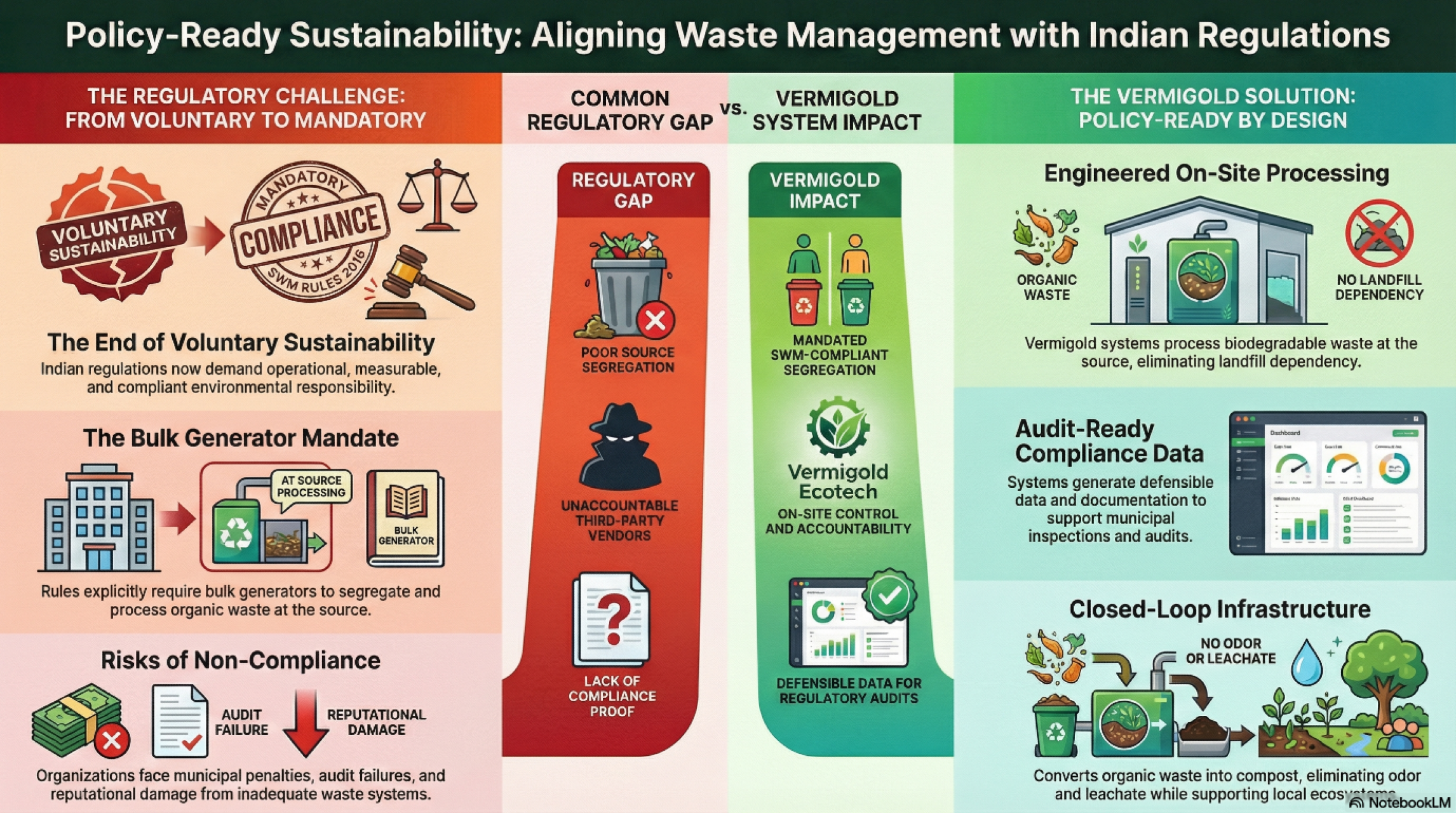
Many organisations in India face a familiar challenge. They have sustainability goals, ESG disclosures, and internal policies—but their waste systems are not aligned with regulatory expectations.
Common gaps include:
Inadequate segregation of waste at source, especially organic waste
Overdependence on third-party waste vendors with limited accountability
Difficulty proving compliance during inspections or audits
Municipal penalties for non-compliance with SWM Rules
Sustainability claims that outpace on-ground systems
Indian regulations are explicit: bulk waste generators are required to segregate, process, and manage organic waste at source. Yet in practice, waste is often mixed, transported off-site, and treated as “out of sight, out of mind”.
This creates risk—not just of penalties, but of reputational damage and regulatory disruption.
The challenge is clear:
How can organisations design waste systems that comply with Indian regulations today—and remain resilient as policies tighten tomorrow?
Designing Waste Systems for Policy Compliance
Policy-ready sustainability begins with system design, not paperwork.
The intent of India’s waste regulations is not punitive—it is structural. Regulators want waste to be managed closer to its point of generation, reducing pressure on landfills, municipalities, and public infrastructure.
This is where decentralised, on-site waste management becomes critical.
At Vermigold Ecotech, waste systems are engineered specifically to align with Indian regulatory requirements while remaining practical for large facilities.
How policy alignment works in practice:
Source segregation of organic waste, as mandated under SWM Rules
On-site processing of biodegradable waste, reducing landfill dependency
Elimination of leachate and odour, addressing public health concerns
Clear documentation and data, supporting inspections and audits
Reduced reliance on municipal collection, easing compliance friction
By converting organic waste into compost on-site, organisations not only comply with regulations but also create a closed-loop system that supports soil health, landscaping, and local ecosystems.
Compliance stops being reactive.
It becomes built-in.
Regulation-Proofing Sustainability for the Long Term
India’s environmental regulations will continue to evolve. Enforcement will become stricter. Reporting expectations will increase. And tolerance for non-compliance will decline.
Organisations that treat sustainability as a checklist will struggle to keep up. Those that treat it as infrastructure will stay ahead.
Policy-ready sustainability means designing systems that:
Meet today’s regulations
Adapt to future policy tightening
Reduce dependency on external actors
Generate defensible compliance data
When waste systems are aligned with regulation by design, sustainability becomes smoother, safer, and more credible.
For Indian businesses, campuses, and institutions, the question is no longer whether compliance is required.
It is how intelligently compliance is embedded into operations.
Because in India’s regulatory landscape, the most sustainable organisations will be the ones that are not just environmentally responsible—but policy-ready by default.
Ready to Build Regulation-Aligned Waste Systems?
📜 Align operations with Indian waste management regulations
📊 Strengthen audit and inspection readiness
♻️ Reduce landfill dependency at source
👉 Speak with the Vermigold team to design waste systems that meet today’s rules—and tomorrow’s expectations.