

Climate change discussions often focus on carbon dioxide—energy use, transport emissions, and industrial fuel consumption. While these are critical, another greenhouse gas quietly accelerates warming at a far more aggressive pace: methane.
Methane is over 25 times more potent than CO₂ over a 100-year period. And one of its largest human-made sources isn’t oil or gas alone—it’s organic waste decomposing in landfills.
Every day, food scraps, garden waste, and biodegradable materials leave offices, factories, campuses, and commercial kitchens. Most of it disappears into bins, trucks, and landfills—out of sight, and often out of climate accounting.
Yet how we manage organic waste may be one of the fastest, most cost-effective ways for businesses to reduce their climate impact.
When Waste Becomes a Climate Multiplier
Organic waste is not inherently harmful. The problem lies in where and how it breaks down.
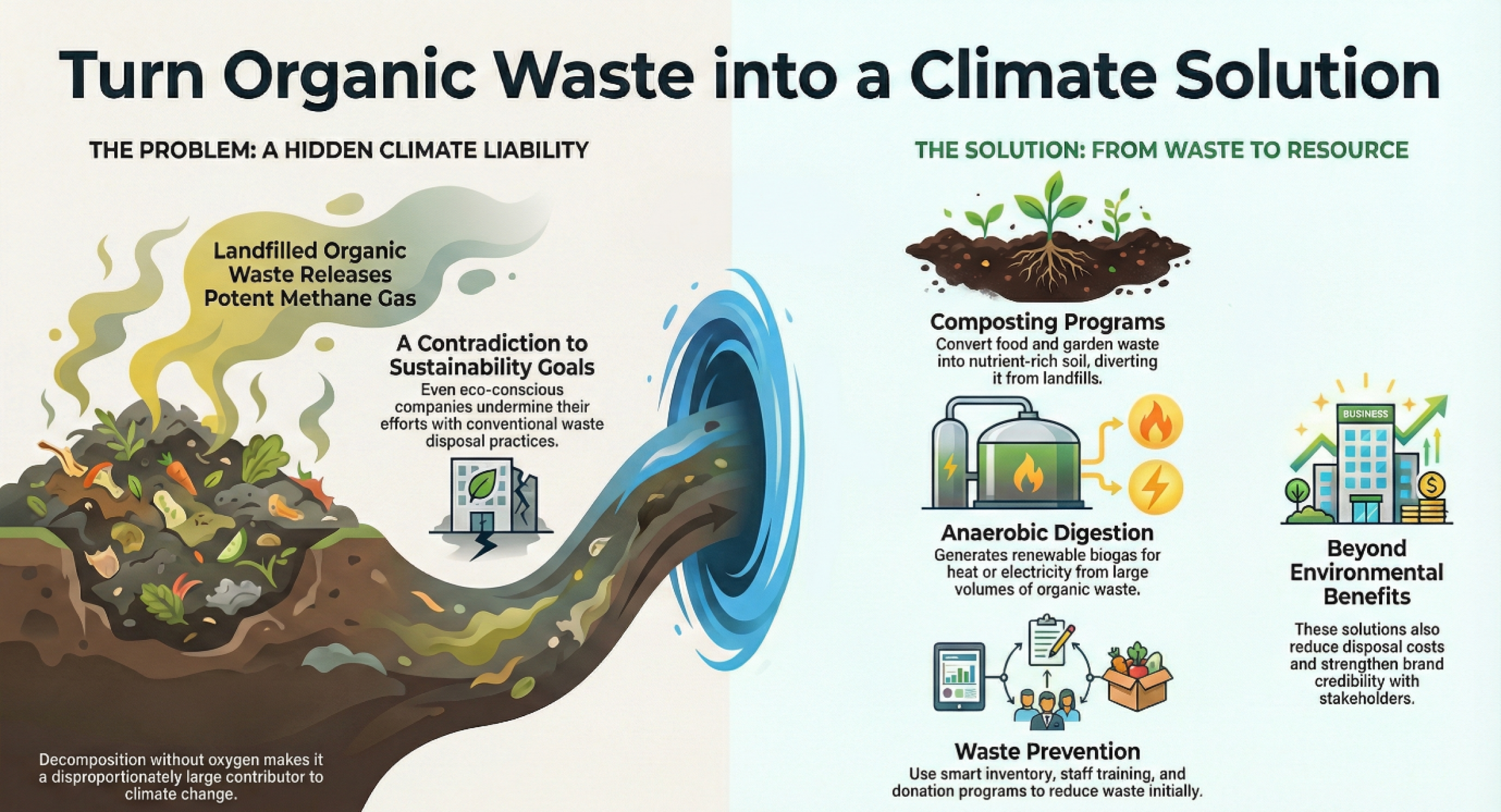
In landfills, organic waste decomposes without oxygen. This anaerobic process produces methane, which escapes into the atmosphere unless captured—something many landfills in India and emerging markets struggle to do effectively.
The consequences are significant:
Landfilled organic waste becomes a high-impact emissions source
Businesses underestimate their true climate footprint
Methane emissions remain largely invisible in ESG disclosures
Waste transport and disposal add secondary carbon emissions
Climate targets rely on offsets instead of real reductions
For corporations committing to net-zero or science-based targets, this creates a blind spot. Even organisations reducing energy emissions may still be contributing substantially to warming—simply through how their waste is handled.
The challenge is clear: how do we stop methane before it is created?
Reducing Methane Where It Begins—At the Source
The most effective methane strategy is also the simplest: prevent organic waste from reaching landfills.
When organic waste is treated aerobically—through composting or controlled biological processes—it breaks down without producing methane. This single shift fundamentally changes the climate impact of waste.
A methane-at-source reduction strategy has three key elements:
Decentralised processing – Treating waste close to where it is generated
Biological recovery – Allowing organic matter to decompose naturally with oxygen
Measurable diversion – Tracking waste to support carbon and ESG reporting
At Vermigold Ecotech, this approach is implemented through decentralised organic waste management systems that convert food and biodegradable waste into nutrient-rich compost within days.
What changes when methane is addressed at source:
Organic waste is diverted before landfill entry
Methane generation is avoided—not offset later
Emissions from long-distance waste transport are eliminated
Compost replaces synthetic fertilisers, reducing upstream emissions
Climate impact becomes measurable and auditable
In real terms, a single large corporate facility can prevent hundreds of tonnes of methane-linked CO₂-equivalent emissions annually—often at a lower cost than purchasing offsets.
This is climate action that is immediate, local, and verifiable.
Methane Reduction Is the Fastest Climate Win Businesses Can Make
Climate leadership is often associated with complex transitions—renewable energy procurement, electrification, or supply-chain restructuring. While essential, these changes take time.
Reducing methane from organic waste does not.
It requires rethinking waste systems, not business models.
By diverting organic waste from landfills and processing it through aerobic, decentralised systems, organisations can deliver near-term climate impact while strengthening ESG performance, regulatory readiness, and operational efficiency.
The science is clear.
The systems exist.
The impact is measurable.
For businesses serious about climate responsibility, methane reduction through organic waste management is not a side initiative—it is one of the most powerful levers available today.
Because the most effective climate action often begins with what we choose not to throw away.
Ready to Reduce Methane at Source?
🌱 Eliminate landfill methane before it forms
📊 Strengthen Scope 3 and ESG climate reporting
♻️ Turn organic waste into a circular, climate-positive resource
👉 Speak with the Vermigold team to design a methane-reduction roadmap for your facilities.