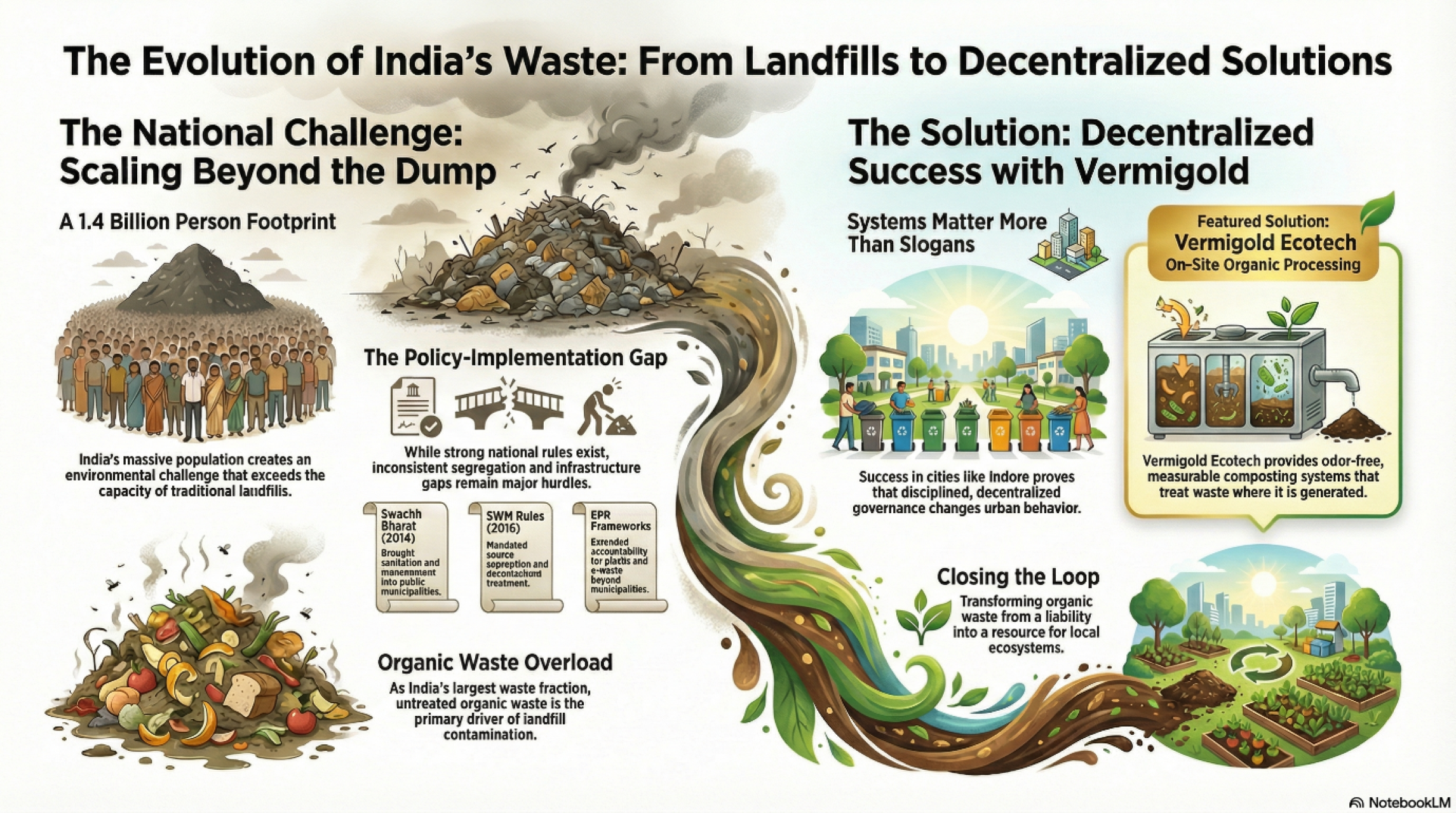
India is home to more than 1.4 billion people—and with that scale comes an unavoidable reality: waste.
For decades, waste in Indian cities and towns followed a simple, damaging path. It was collected sporadically, dumped openly, and forgotten. Open landfills became fixtures on city edges, contaminating air, soil, and water while posing serious public health risks.
As urbanisation accelerated and consumption patterns changed, it became clear that this approach was no longer viable. Waste was no longer just a municipal inconvenience—it had become a national environmental challenge.
This realisation marked the beginning of India’s waste management evolution.
Progress on Paper, Gaps on the Ground
India’s shift toward structured waste management has been driven largely by policy reform and national missions.
Key milestones reshaped the landscape:
Municipal Solid Waste Rules, 2000 laid the first foundation for organised collection and disposal
Solid Waste Management Rules, 2016 strengthened segregation-at-source, processing, and decentralised treatment
Swachh Bharat Mission (2014) brought sanitation and waste segregation into public consciousness
Plastic Waste Management Rules and EPR frameworks extended accountability beyond municipalities
These interventions sparked visible improvements. Many cities adopted door-to-door collection. Awareness around segregation increased. Waste processing infrastructure began to emerge.
Yet, despite this progress, deep challenges remain.
Segregation at source is still inconsistent. Mixed waste continues to reach landfills. Organic waste—India’s largest waste fraction—often goes untreated. Plastic and e-waste volumes rise faster than systems can absorb them. Many municipalities struggle with limited infrastructure, funding gaps, and weak enforcement.
The contradiction is clear:
policy intent is strong, but implementation remains uneven.
What India’s Success Stories Reveal
Where India has succeeded, one lesson stands out—systems matter more than slogans.
Cities and communities that moved beyond centralised dumping toward decentralised, accountable systems saw meaningful change.
Indore transformed cleanliness outcomes through strict segregation, complete door-to-door collection, and robust composting and recycling systems—proving that governance and discipline can change urban behaviour.
Pune’s SWaCH cooperative demonstrated how integrating informal waste pickers into formal systems can improve segregation while creating dignified livelihoods.
Kerala’s decentralised models, particularly in towns like Alappuzha, showed that community-level composting and source management can dramatically reduce landfill dependence.
Across these examples, organic waste management played a critical role. Treating biodegradable waste close to where it is generated reduced transport burdens, lowered emissions, and returned nutrients to local ecosystems.
Technology and decentralised solutions—such as on-site composting systems engineered by Vermigold Ecotech—have further strengthened this shift by making daily waste processing practical, odour-free, and measurable.
These successes point to a common truth:
India’s waste problem is not unsolvable—it is systemic.
The Road Ahead Is Decentralised, Measurable, and Collective
India’s waste management journey is still unfolding.
The next phase will not be defined by new rules alone, but by how effectively existing rules are translated into everyday practice. This requires:
Consistent segregation at source
Stronger investment in composting and recycling infrastructure
Scalable, decentralised waste processing models
Behavioural change supported by enforcement and incentives
Collaboration between governments, businesses, communities, and solution providers
Waste management in India can no longer rely on end-of-pipe solutions. The future lies in closing loops—especially for organic waste—so that materials re-enter productive use instead of accumulating in landfills.
India has already shown that transformation is possible. The challenge now is scale, consistency, and long-term commitment.
If the lessons from successful cities are applied nationwide, waste can shift from being an environmental liability to a resource that supports cleaner cities, healthier communities, and a more resilient future.
India’s waste management evolution is not finished.
But the direction forward is clear.