

Across India, green buildings are becoming the norm rather than the exception. Corporate campuses, IT parks, residential complexes, hospitals, and institutional buildings are increasingly designed to reduce energy use, optimise water consumption, and lower overall environmental impact.
Yet as Net Zero ambitions mature, a critical insight is emerging:
Energy efficiency alone does not make a building Net Zero.
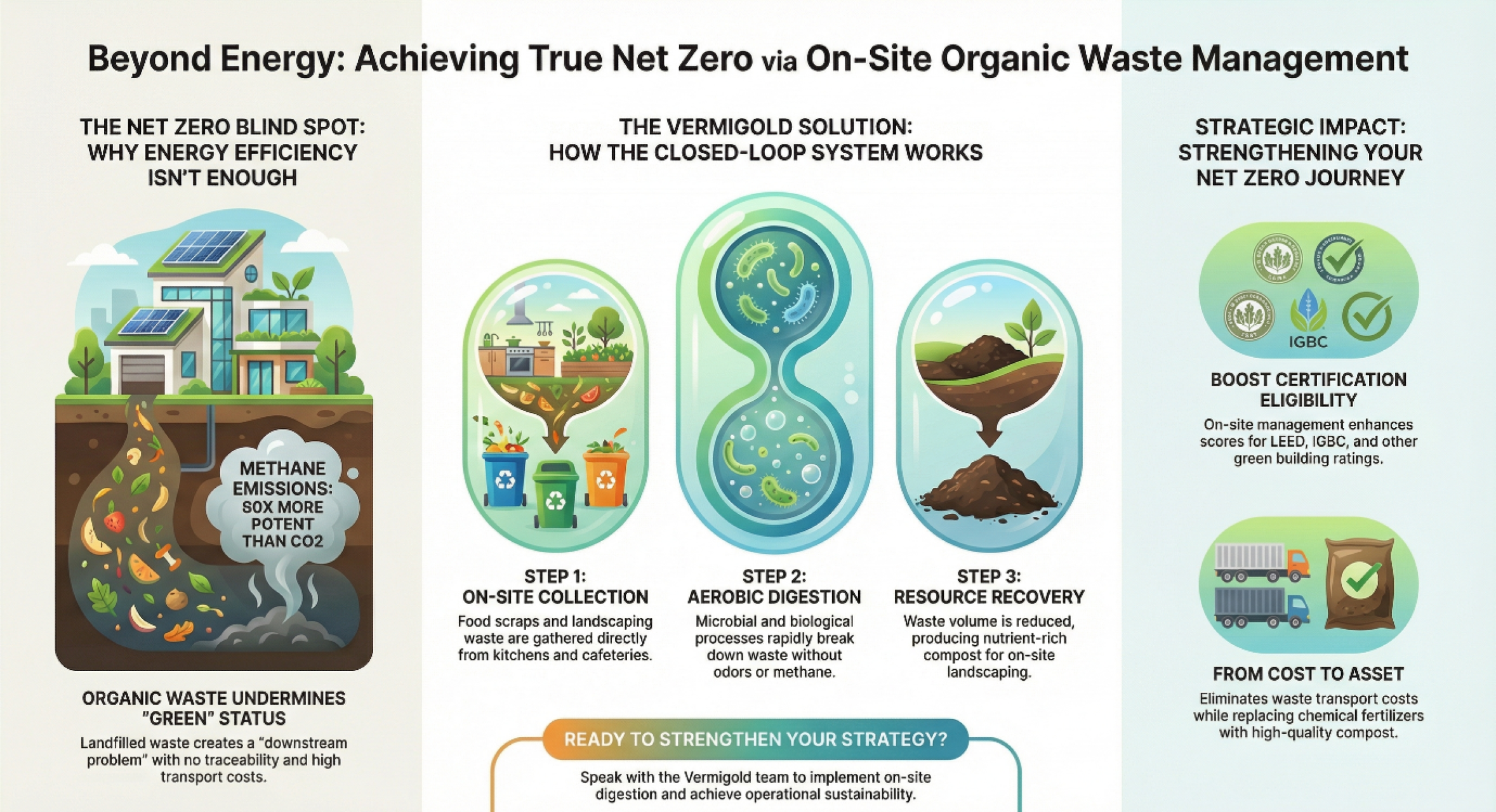
Waste—especially organic waste—plays a decisive role. Food scraps from cafeterias, landscaping waste, and biodegradable materials generated daily can quietly undermine even the most energy-efficient building if they are sent to landfills.
For green buildings in India, achieving Net Zero increasingly depends on how waste is handled on-site.
The Organic Waste Blind Spot in Green Buildings
Most green buildings are designed with energy, water, and materials in mind—but organic waste is often treated as a downstream problem.
Common challenges include:
Food waste transported off-site to landfills
Methane emissions generated outside the building boundary
Dependence on municipal collection with limited traceability
Rising waste transport and disposal costs
Difficulty meeting zero-waste or landfill-diversion targets
In the Indian context, this is particularly significant. Organic waste forms a major portion of total waste generated in buildings, and when landfilled, it decomposes anaerobically—producing methane, a greenhouse gas far more potent than CO₂.
The result is a contradiction:
a “green” building that still contributes indirectly to emissions and landfill pressure.
To move closer to Net Zero, this gap must be addressed at source.
Closing the Loop with On-Site Organic Waste Digestion
The turning point comes when organic waste is treated not as refuse, but as a resource within the building system.
At Vermigold Ecotech, the Organic Waste Digester is designed specifically for Indian green buildings—compact, odour-free, and suitable for continuous, daily waste generation.
How the system works in practice:
Organic waste from kitchens, cafeterias, and landscaping is collected on-site
Aerobic microbial and biological processes rapidly break down waste
Waste volume is reduced significantly within days
Nutrient-rich compost is produced for on-site landscaping or green spaces
By processing organic waste within the building boundary, green buildings achieve several Net Zero–aligned outcomes simultaneously:
Methane emissions are avoided at source
Waste transport and landfill dependency are eliminated
Closed-loop material cycles are established
Compost replaces chemical fertilisers for landscaping
This transforms waste management from a logistical cost into an environmental asset.
Net Zero Buildings Are Built on Closed-Loop Systems
For Indian green buildings, the path to Net Zero is becoming clearer.
It is no longer enough to optimise energy alone.
True Net Zero demands systems thinking—where energy, water, and waste are designed as integrated loops.
On-site organic waste digestion plays a critical role in this equation by:
Supporting zero-waste and landfill-diversion goals
Strengthening compliance with Indian sustainability norms
Enhancing eligibility for green building certifications
Reducing operational costs and long-term environmental risk
When organic waste is managed within the building ecosystem, sustainability stops being aspirational and becomes operational.
Net Zero, in this sense, is not a label—it is a discipline.
And green buildings that close the organic waste loop take a decisive step toward making that discipline real.
Ready to Strengthen Your Green Building’s Net Zero Strategy?
🏢 Process organic waste on-site, without odour or landfill reliance
📊 Reduce emissions and improve sustainability metrics
♻️ Create closed-loop systems aligned with Net Zero goals
👉 Speak with the Vermigold team to understand how on-site organic waste digestion can support your green building journey in India.