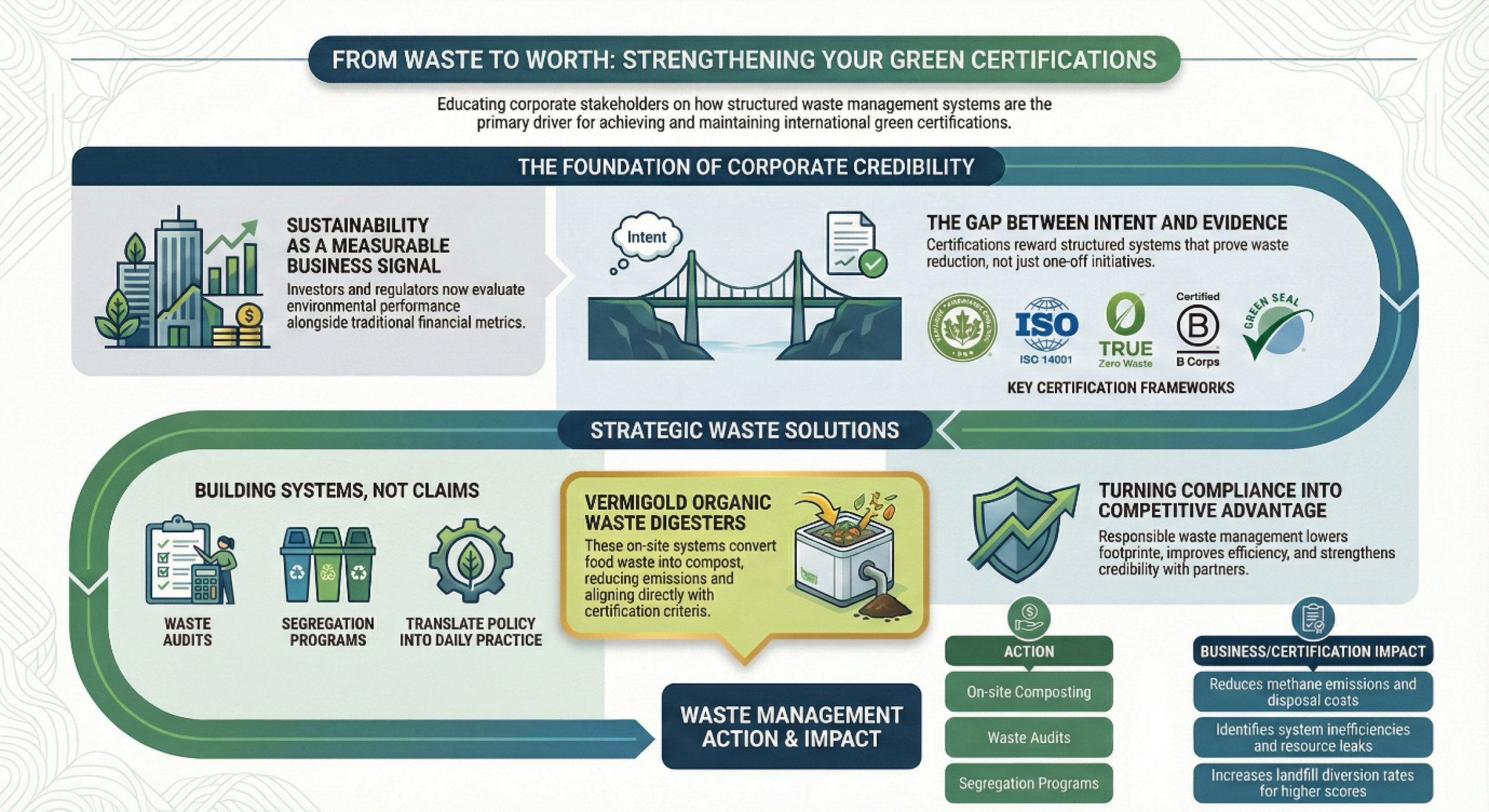
Not long ago, sustainability was treated as a brand accessory - something highlighted in annual reports or marketing campaigns. Today, it has become a measurable business signal.
Customers ask tougher questions. Regulators demand clearer accountability. Investors increasingly evaluate environmental performance alongside financials. In this environment, green certifications have emerged as a common language of credibility—helping businesses demonstrate that their sustainability claims are backed by action.
Among the many pathways to earning these certifications, one stands out for its impact and visibility: waste management.
Intent Alone Is No Longer Enough
Many organisations want to operate sustainably. Fewer are able to prove it.
Waste is often the weakest link. Organic waste sent to landfills generates methane, inflates disposal costs, and undermines environmental performance metrics. Poor segregation, reliance on single-use materials, and opaque disposal practices can quietly erode a company’s sustainability score—even when intentions are strong.
At the same time, green certifications demand evidence. They reward businesses that can demonstrate waste reduction, diversion from landfills, and responsible resource use through structured systems—not one-off initiatives.
The challenge is clear: how can businesses translate sustainability intent into verifiable outcomes?
Certifications Are Built on Systems, Not Claims
Green certifications provide a framework for turning sustainability into practice—and waste management is central to many of them.
Standards such as LEED, ISO 14001, TRUE Zero Waste, B Corp, and Green Seal all emphasise waste reduction, recycling, composting, and continuous improvement. They look beyond end results and evaluate how well systems are designed, monitored, and improved over time.
This is where effective waste management becomes a strategic advantage.
Conducting waste audits reveals inefficiencies.
Segregation and recycling programs reduce landfill dependency.
Replacing single-use materials improves resource efficiency.
Employee training ensures consistency and accountability.
For organic waste in particular, on-site processing solutions can dramatically strengthen certification outcomes. Systems like the Vermigold Organic Waste Digester enable businesses to convert food and biodegradable waste into compost or liquid fertiliser—reducing emissions, cutting disposal costs, and aligning directly with certification criteria.
By integrating such systems, sustainability shifts from policy to practice.
Turning Waste Compliance into Competitive Advantage
Green certifications are not just about compliance. They are about trust.
When waste is managed responsibly, businesses lower their environmental footprint, improve operational efficiency, and strengthen their credibility with customers, regulators, and partners. Certifications become easier to achieve—and easier to maintain—because sustainability is embedded into daily operations.
With the right approach, waste stops being a liability and becomes a measurable asset.
For businesses pursuing LEED, ISO 14001, TRUE, B Corp, or Green Seal certification, the path forward is clear: design systems that reduce waste at source, close material loops, and deliver verifiable impact.
Sustainability is no longer about saying the right things.
It’s about building the right systems.
And when waste is managed well, both the planet and the balance sheet benefit.