

n the early days of corporate sustainability, governance was often the quiet pillar of ESG—overshadowed by environmental targets and social initiatives. Today, that has changed.
As ESG reporting becomes more regulated, scrutinised, and investor-driven, governance has emerged as the backbone that determines credibility. It is no longer enough for organisations to do the right things. They must be able to prove them - with data, documentation, and consistency.
Nowhere is this shift more visible than in how companies manage and report waste.
When Sustainability Efforts Fail the Governance Test
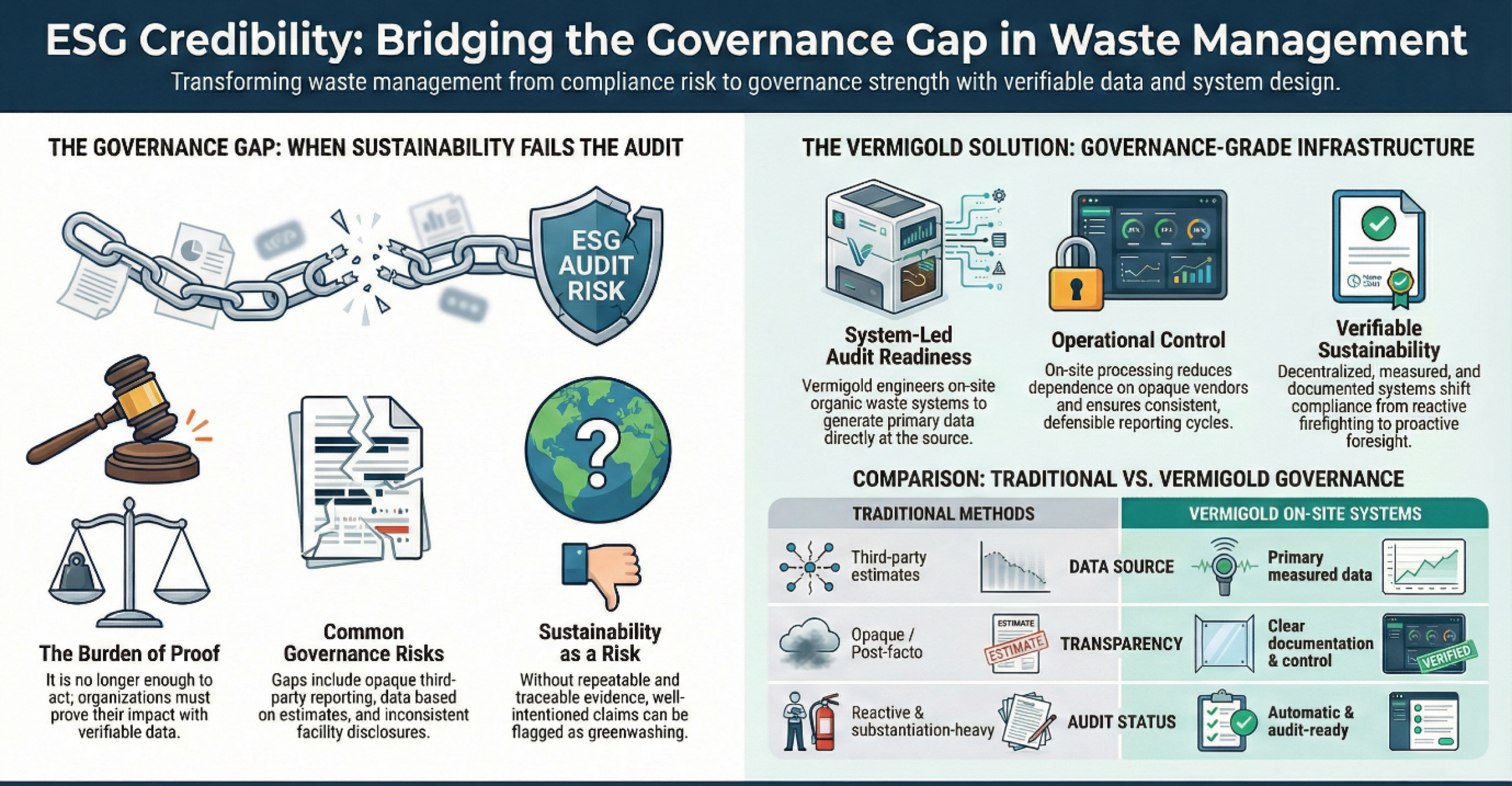
Many organisations invest heavily in sustainability initiatives, yet struggle during audits, disclosures, or regulatory reviews. The reason is rarely a lack of action—it is a lack of verifiable systems.
Common governance gaps include:
Waste handled by third-party vendors with limited transparency
ESG disclosures based on estimates rather than measured data
Inconsistent reporting across sites and facilities
Difficulty substantiating environmental claims during audits
Rising regulatory pressure to prevent greenwashing
In such environments, sustainability becomes a governance risk. Even well-intentioned claims can be questioned if they are not supported by auditable evidence.
For boards, compliance officers, and audit committees, this creates discomfort. Governance demands repeatability, traceability, and accountability—not assumptions.
Designing Waste Systems for Governance, Not Just Operations
Strong governance begins with system design.
When waste management is embedded into core operations—with clear processes, measurable outputs, and defined ownership—it naturally becomes audit-ready. This is especially true for organic waste, which represents a large, high-impact, and highly regulated waste stream.
At Vermigold Ecotech, waste management is engineered to support governance outcomes as much as environmental ones.
On-site organic waste management systems enable organisations to:
Generate primary data on waste processed and diverted
Maintain clear documentation for ESG, CSR, and statutory disclosures
Reduce dependence on opaque third-party reporting
Align sustainability actions with regulatory expectations
Support internal and external audits with confidence
Instead of relying on post-facto certificates or vendor claims, organisations retain operational control—and with it, governance clarity.
Waste data becomes consistent, repeatable, and defensible across reporting cycles.
Audit Readiness Is a Governance Outcome, Not an Afterthought
The strongest ESG performers share a common trait: governance is built into their systems, not added later.
When waste management is decentralised, measured, and documented at source, audit readiness becomes automatic rather than reactive. Compliance shifts from firefighting to foresight. Sustainability claims move from narrative to evidence.
In an era of tightening regulations, anti-greenwashing rules, and investor scrutiny, governance is what separates genuine sustainability leaders from those exposed to risk.
For organisations serious about ESG maturity, the question is no longer whether to improve waste management—but how well it supports data integrity, compliance, and audits.
Because in the end, sustainability that cannot be verified
is sustainability that cannot be trusted.
Strengthen Governance Through Measurable Waste Systems
📊 Build audit-ready ESG data at source
📑 Reduce compliance and greenwashing risk
♻️ Design waste systems that stand up to scrutiny
👉 Connect with the Vermigold team to design governance-grade waste infrastructure for your organisation.