

Today, regulators, investors, and consumers expect sustainability claims to be specific, measurable, and verifiable. Anti-greenwashing regulations, tighter ESG disclosure norms, and rising audit scrutiny have transformed ESG from a branding exercise into a governance responsibility.
In this new environment, the question for businesses is no longer “Do we have sustainability initiatives?”
It is “Can we prove them?”
When Good Intentions Become Governance Risk
Many organisations genuinely invest in sustainability. Yet they still face greenwashing risk—not because they are misleading, but because their systems are not built for verification.
Common failure points include:
Vague environmental claims without supporting data
Reliance on third-party waste vendors with limited transparency
ESG disclosures based on estimates rather than primary data
Selective reporting that highlights positives while omitting gaps
Last-minute audit preparation instead of continuous compliance
As ESG regulations tighten, these gaps become liabilities. Claims that once went unquestioned can now attract regulatory action, investor skepticism, or reputational damage.
The core issue is structural: sustainability actions are often real, but the systems behind them are not auditable.
From Sustainability Claims to Sustainability Systems
True ESG compliance is not achieved through better language. It is achieved through better system design.
Verifiable sustainability systems share three defining characteristics:
They generate data at source, not after the fact
They are repeatable and consistent across sites
They integrate compliance into daily operations
Waste management—especially organic waste—is one of the most powerful starting points for building such systems. It is high-volume, high-impact, and highly scrutinised under ESG and environmental regulations.
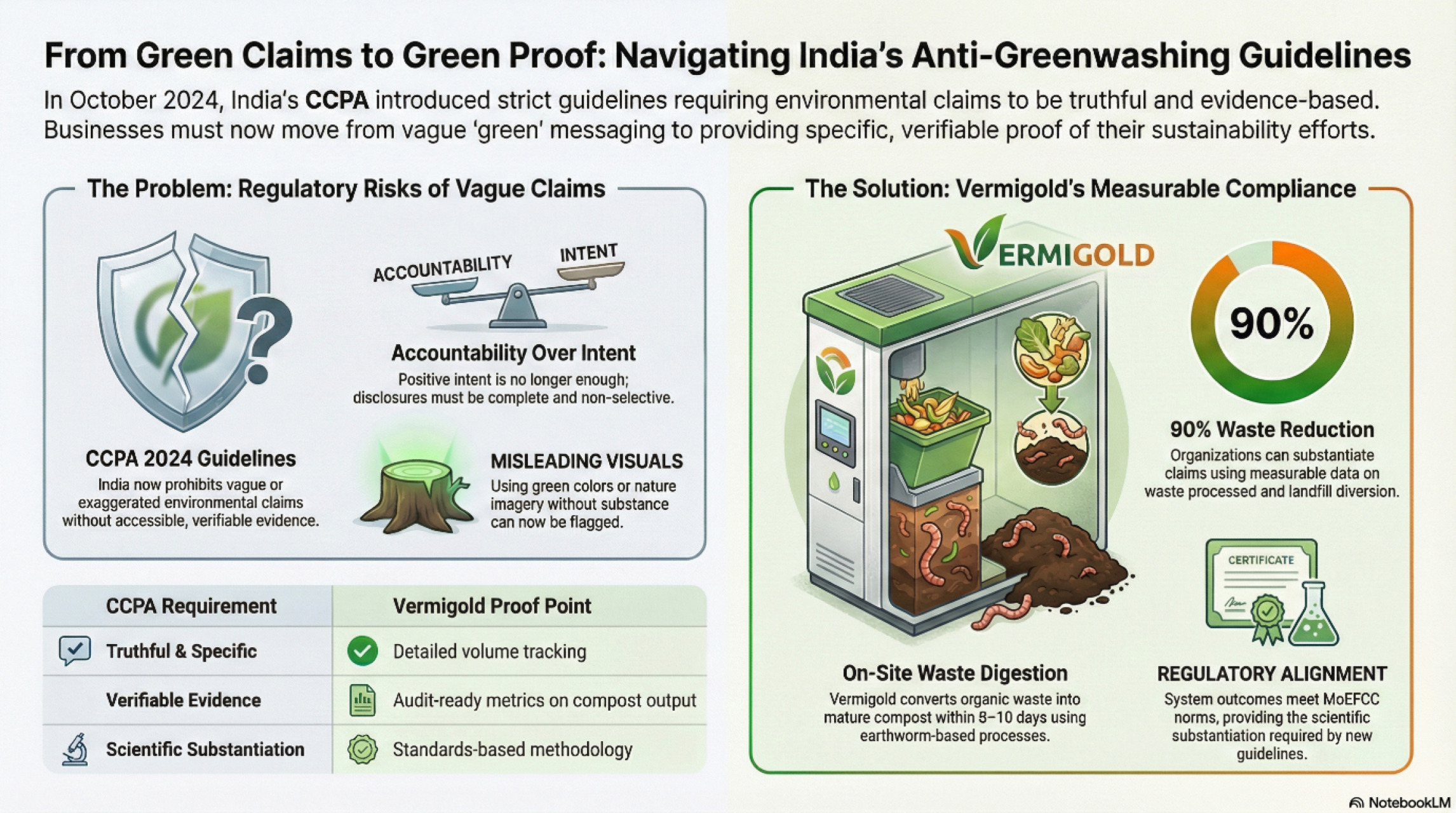
At Vermigold Ecotech, sustainability is operationalised through decentralised, on-site organic waste management systems that prioritise measurability and transparency.
By processing organic waste at source, organisations can:
Quantify waste diversion from landfills
Substantiate emissions reduction claims
Maintain consistent documentation for ESG, CSR, and statutory reporting
Reduce dependence on opaque third-party certificates
Align environmental claims with operational reality
In this model, sustainability data is not manufactured for reports—it emerges naturally from operations.
That is what makes it defensible.
Compliance Is the Outcome of Good Design
The strongest defence against greenwashing is not restraint in communication, but confidence in systems.
When sustainability is embedded into infrastructure—measured daily, documented automatically, and audited continuously—compliance becomes routine rather than reactive. ESG reporting shifts from narrative-building to evidence-sharing.
In a regulatory environment that increasingly penalises ambiguity, organisations that invest in verifiable systems will move faster, face less risk, and earn greater trust.
ESG leadership is no longer about saying the right things.
It is about building systems that make the truth easy to prove.
And in that future, sustainability will not be judged by promises—but by processes.
Build ESG Systems That Stand Up to Scrutiny
📊 Generate audit-ready sustainability data at source
📑 Reduce greenwashing and compliance risk
♻️ Align ESG claims with real operational outcomes
👉 Connect with the Vermigold team to design verifiable sustainability systems for your organisation.