

Over the last few years, ESG has evolved rapidly. What began as voluntary reporting and reputation management has now entered a more demanding phase—one shaped by regulation, investor scrutiny, and long-term risk management.
Boards are asking harder questions.
Investors want comparable, verifiable data.
Regulators are tightening disclosure and anti-greenwashing norms.
In this environment, ESG is no longer something organisations can manage through policies, targets, or annual reports alone. It is becoming something far more structural:
ESG is turning into infrastructure.
Just as companies once had to build digital, financial, and compliance infrastructure to scale, they now face the same imperative with sustainability—especially as expectations extend well into the next decade.
Why ESG Initiatives Struggle to Age Well
Many organisations have launched ESG initiatives over the past five years. Fewer are confident those initiatives will still stand up to scrutiny ten years from now.
The reason is structural fragility.
Common challenges include:
ESG programs built as projects rather than systems
Heavy dependence on third-party estimates and certificates
Inconsistent data across sites and geographies
Sustainability claims that outpace operational reality
Rising risk of regulatory non-compliance and greenwashing exposure
As expectations grow, these weaknesses become visible. What worked for early-stage ESG reporting often fails when subjected to audits, comparisons, or enforcement.
The uncomfortable truth is this:
ESG initiatives without infrastructure do not scale—and they do not endure.
What ESG Infrastructure Actually Looks Like
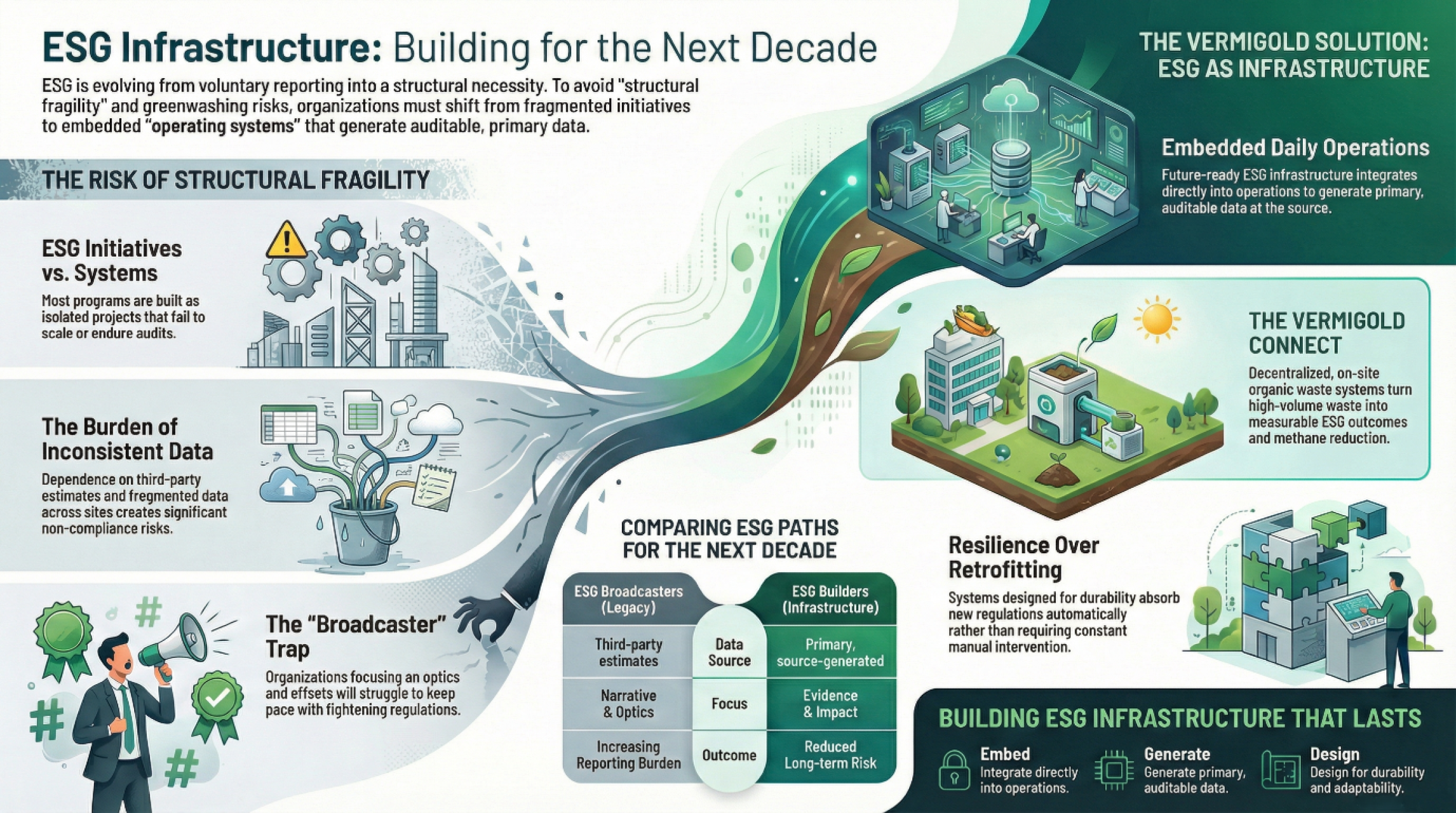
Designing ESG infrastructure for the next decade requires a shift in mindset—from initiatives to operating systems.
Future-ready ESG infrastructure has three defining characteristics:
It is embedded into daily operations
It generates primary, auditable data
It reduces long-term risk rather than creating reporting burden
Waste management—particularly organic waste—is one of the most powerful starting points for this transformation. It is high-volume, highly regulated, climate-relevant, and present across nearly all large organisations.
At Vermigold Ecotech, ESG infrastructure is built by designing decentralised, on-site organic waste systems that deliver measurable outcomes every day.
When ESG is designed as infrastructure:
Waste diversion data is generated at source
Methane emissions are reduced before they occur
Compliance aligns naturally with Indian and global regulations
ESG reporting becomes evidence-based, not narrative-driven
Systems remain effective even as policies and standards evolve
Instead of retrofitting sustainability into operations, sustainability becomes part of how operations function.
That is what allows ESG systems to remain relevant—not just next year, but throughout the next decade.
The Next Decade Will Reward ESG Builders, Not ESG Broadcasters
The coming decade will mark a clear divide.
On one side will be organisations that continue to manage ESG through announcements, offsets, and fragmented initiatives—constantly catching up with regulation and scrutiny.
On the other will be organisations that invest early in robust ESG infrastructure—systems that quietly generate data, reduce risk, and deliver real impact without constant intervention.
The latter will find ESG easier, not harder, over time.
Designing ESG infrastructure is not about predicting every future regulation.
It is about building systems resilient enough to absorb them.
For organisations serious about long-term sustainability, the question is no longer whether to invest in ESG infrastructure.
It is how early—and how intelligently—they choose to do it.
Because in the next decade, ESG leadership will belong to those who designed for durability, not optics.
Ready to Build ESG Infrastructure That Lasts?
🏗 Embed sustainability into core operations
📊 Generate audit-ready ESG data at source
♻️ Design systems resilient to future regulation
👉 Speak with the Vermigold team to design ESG-grade waste infrastructure built for the next decade—not just the next report.